August 25, 2010

Library maps


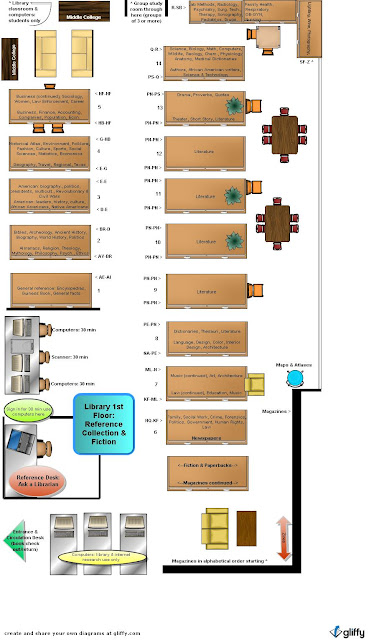
I've been dabbling in cartography for our library, drawing out (virtually) and labeling our downstairs and upstairs to help students navigate the stacks better (only showing first floor map here). We do have labels on the shelving, as well as LCSH guides, but this can help make it more visual and holistic.

I mentioned this task very briefly in a former post but now I have the finished products. We plan to post these maps on the bookcases, create smaller handouts students can take, and also post it on our website. Instead of just having a static map as a tab on our LibGuides, I made the suggestion we use photo editing software to create circles or highlights over each subject area's related locations to customize the maps for various departments.

As a review of Gliffy, I really liked it, and it's free. If you select to have objects snap to grid and align, it makes having repeating objects much easier to deal with. As you can see, there are also options for color and text styles/fonts. I also liked the variety of floorplan objects you can select to make furniture look close to what your library might have. Did I mention it's free? That's a huge plus.

The subjects chosen to be shown on the bookcase images (if you can even read them -- text is harder to read on the maps when posted here via Blogger) are ones that directly relate to classes offered and highlighted programs. For example, students are less likely to look up photography books here, and more likely to look up architecture and interior lighting for buildings because of our interior design program, and lack of a photography program.

It will hopefully be less intimidating for students to navigate the library having a map ahead of time; this should also really encourage browsing. I'm excited for when we get them posted to see what the reaction will be.

A slicker example I saw recently of a library map is the University of Arizona's virtual tour but I believe from what a colleague mentioned that it was not free. The pop-ups with photos do look really nice.

July 1, 2010

Early career credibility

I've been thinking about credibility a lot lately -- credibility with students and in collaborative relationships with faculty. Being a new librarian, it can be difficult to gain trust when not only are you new to the organization, but also new to the profession. Some students are set in their ways with asking for help from a particular librarian, and some faculty do not seem as open to working with a new person they don't really know very well. Not always having the answers and having to ask another librarian for input doesn't always help the case.

When I asked my very excellent ACRL Instruction Section mentor what to do if someone asks a question in a session I am teaching and I do not know the answer, she told me it's okay to say that it is a good question and I'm not sure of the answer but will find out. This also applies to the reference desk; my supervisor has encouraged me to come to her with questions because since I am new, I am not expected to know everything. I have only had one teaching experience at this point, but when I'm on the desk and a student asks me something I don't know, I will first try to find the information together. On one hand, this can really work to my advantage by turning it into a teachable moment because once we do arrive at the information being sought, I can say "hey you did great it's really just trial and error," and it makes the student feel more comfortable with the library as well as asking me for help. That really has been one of my favorite scenarios.

However, and this has happened a bit too, when a student asks me a question and I really am baffled, I will have to say I'm not as familiar with that subject as my supervisor but I will go find out or go ask her to assist them. I've had a few individuals approach me at the desk and ask for my supervisor specifically, when I say she is not available, I really have been asked if I "know what she knows." I will tell them I might not know everything she knows but I know a good amount and would they like me to help them. Usually, the student will say yes and I am able to answer their question (or figure out where to find the answer). I feel like with the students, this will just take time for them to get used to seeing a new face and that I am able to be helpful.

When I see students again that I have helped, I make sure to follow up with them and ask how their paper or presentation went, and that usually seems to help form more of a relationship. Now I do have students come back to me for help without hesitation, albeit there still are a few that only want help from a specific librarian. Building relationships first with faculty, outside of anything having to do with the library, is another great piece of advice my mentor gave me.

I have not yet met most of who I will be working with from the faculty since it is summer, but I have been trying to provide good service regardless of whether it was asked for or not. For example, I am now sending out emails about new books to instructors in certain subject areas, and I plan to ask for input on collection development once I have more interaction with them; if I don't know an answer to a question, I follow up as soon as possible. One instructor came in looking for an online version of the Oxford English Dictionary, and I wasn't sure offhand if we subscribed electronically; my database and then catalog search took a little longer than I had hoped, so I made sure to later email him to follow up and point out the other online dictionaries we have instead of the OED and let him know where the print version was located for future reference.

I think I will need to explore faculty collaborations a bit more because I know some instructors in my subject areas do not bring their classes to the library (never have and don't necessarily plan to), and I hope to find a way to work with that -- or at least come to a compromise of sorts. Again, a lot of this will just take time, but I'm trying to get on the right track from the start. Hopefully, once I'm introduced to more instructors in my area I will have more opportunities.

June 22, 2010

Trial by fire

Yesterday wound up being my first foray into library instruction. An instructor accidentally mixed up the times given for bringing his class in, so shortly before they would be arriving, my supervisor approached me at the reference desk with, "Guess what... you will be teaching today!" She was already scheduled to teach a class in the classroom, so I had to cover the other class on the computers by the entrance area. Part of my position is instruction, but it wasn't going to be for about another month until I would start.

Nothing like trial by fire as a few colleagues had mentioned to me later on. I had a slight case of terror, but at least previously sat in on a few of my supervisor's instruction sessions to be somewhat familiar with the material. I also figured there was no point in being nervous, because I didn't really have time. I was given the handouts the students get and was able to use those as my lesson plan; they also would serve as visuals since I didn't have the use of a computer/projector.

We went over what I would cover, and I was able to do a very quick run through until the class came in. I definitely had the jitters at first while passing out the handouts, but I think it was one of those things only you notice. As Olivia Mitchell said in regards to anxiety in public speaking,
Just like we don’t see the energetic paddling as a swan glides across the water, you don’t look as nervous as you feel.
Overall, I would say it went well. One of the biggest challenges was going at a pace that would keep the students who had already done similar exercises for other classes engaged, while also not going so fast that the students having more trouble would fall behind. I did end exactly on time, which was great, but I could tell about a third of the class was bored. I did find out later that a lot of that class was from our early college, so I had many high school students on the fast track. That helped me feel a little better about hearing a giggle or two, and I'm sure once I have more practice that wouldn't phase me.

Using analogies, such as going to different databases is like going to different stores when shopping, seemed to help the students who were struggling more to understand better. I would have liked to use more examples like that, but was more focused on getting across the correct information first.

Working in more humor is another goal I have for next time. I did see via the information literacy instruction discussion list (I believe) that someone is working on collecting information about using humor in library instruction, so I'd like to see the results of that when they are available. What I did do that my supervisor suggested was review how to get to the appropriate databases when the students would not be in the library: the scenario of being at home, waking up in the middle of the night, and just being so excited to do some research, what would you do to get to where we just went?

I think these improvements will come in time, but I am keeping notes of what I did well and what I'd like to work on so I can see progress as I teach more classes.

May 11, 2010

Week 2, day 2

There was quite a big gap in posting, but now that I'm all settled in TX and have started work, I think I'm more able to give some attention to my blog.

Today was week two, day two at my new job and I think I'm adjusting well. In case you missed my previous post, I took a position as a reference/instruction/collection development librarian at an urban community college in downtown Dallas. There is a lot to learn but my new supervisors and coworkers are understanding about information overload and being able to remember it all. I wanted to write about my initial perceptions and experiences at my first library job before I might forget, to reflect from the perspective of a recent graduate.

My paranoia was right: library school is not enough

(so I'm glad I went overboard in gaining hands-on experience outside of the classroom)

Library school certainly gave me enough theory and understanding of how to keep up with library news and topics so that I can have an intelligent conversation with other librarians and stay current professionally, but what is really helping me keep up right now in a live environment is my previous library work experience, as well as previous jobs in customer service. I honestly kiiiind of shrugged off how important my customer service experience in positions such as a lowly sales clerk would be, but it does make a big difference.

Every library school program has its pros and cons, and as happy as I am with what I took away from SIRLS, the reference class I had was very weak (and the instructor is no longer there if that says anything). It was 100% theory, with no practical experience, without even practicing on classmates. Because I had some previous experience in sales and virtual reference I feel a little better, but if I hadn't done an internship or had the position I had prior to my current job, I think I would have had more difficulties (and perhaps not gotten the job anyhow). However, whether a program has a great reference class or not, that work experience is invaluable! I highly urge current students to work or volunteer to get that background.

A Master's degree does not automatically equal expert


I'm glad I had spoken with others about how they felt on their first day at their first job, not just in LIS, but other fields; a common newbie misconception (and huge stressor) is believing just because one has a Master's that they should automatically be an expert and know everything. Every library is different, with different databases, OPACs, and procedures, so learning a lot on the job is necessary. When I don't know how to answer a student's question immediately, my first response is still to beat up on myself a little and get stressed, but I don't think it's possible for a new librarian to know how to do everything. When I shadow at the reference desk, it seems to be understood that there is a learning period, so I think I need to give myself a break (which I'm slowly learning to do better), and the more relaxed I am, the better customer service I can provide.


Watch and learn, do and learn


The best way to learn everything I need to get familiar with is to just watch others (shadowing) and then try it myself and learn from my mistakes. That was how I best remembered which supplement aids which ailment and is located in which section of the store when I worked in natural health, and it is how I'm best remembering how to help students find information in the library now. I've also taken a copy of every pathfinder and library guide created for our library so I can read them all over in my office when I have some down time. Practicing with the OPAC and various databases while it's slow at the desk is also very helpful. We have a binder of assignments instructors have shared with the library, so something else I'm going to do when I have more time is to try doing as many assignments on my own as I can so I know what the students will be going through (doing the just the research, not also writing the papers, of course).

I haven't started instruction yet (not until summer sessions), but I can say for reference, you just have to jump in and do it to learn. Making mistakes in front of students isn't fun, but it does at least show them you're human and gives you the chance to find out the answer for future questions.