October 10, 2013

TMI Instruction and Student Retention

In my Educational Psychology course I'm taking this semester, we were discussing effectiveness of instructor transparency on student motivation. Because people ascribe more positive attributes to others who appear "warm" (rather than "cold"), it seemed like it could be a good thing to be forthcoming with personal information to students. For example, how an instructor had a hard time learning x subject and overcame it, or even addressing if an instructor received negative reviews on TCEs, etc. My opinion was to not show much weakness. You can really hurt your credibility with students who are looking to you as an expert on a topic and the authority figure for the classroom if you try to take yourself down a few notches to be on the same level as them. It sort of makes me think of He's Hip. He's Cool. He's 45! From Kids in the Hall:


Edit: @kellymce pointed out this is another good example (and a much better one, I think!):


Students can sniff out a try-hard. Sometimes I'm tempted to share, particularly when I'm working with student retention-related groups, that I dropped out of college for awhile and also hated using the library and didn't care to ever learn. But I don't! Because I'm supposed to be the authority in the class and I'm in charge. Can you imagine if you went to a therapist and they started telling you about all their psychological issues? Their credibility would be shot, and it would also be very confusing as to why they are sharing this information. As instructors, we are there to teach a particular subject and guide students to learning. We can relate to them in small ways, in a mentor-ish capacity, but emptying out the closet skeletons is not an effective way to motivate or draw students into learning.

Anyhow, these are my thoughts and I realize how strong they are after reading this article that came out today on Inside Higher Ed: TMI from Professors (study indicates role of over-sharing by professors in encouraging uncivil student behavior). Apparently, students are less likely to behave well in class if you try and rap with them (as in the outdated 70s slang for talk/relate to). Check it out, interesting stuff.
"When students reported that their instructors engaged in a lot of sharing about their lives -- particularly stories about past academic mistakes, even stories designed to stress that everyone has difficulty learning some topics -- there is an immediate and negative impact on classroom attitudes."

September 9, 2013

Reflection on Feminist Pedagogy for Library Instruction (book)

image from powderroom.jezebel.com
I just finished reading Maria T. Accardi's Feminist Pedagogy for Library Instruction (Library Juice Press, edited by Emily Drabinski). Aside from it resonating with me because I do try to employ critical library instruction and feminist pedagogy when I can, a lot of what Accardi discusses in the book also relates to what I'm doing with digital badges and also student retention.

First, for some background, Accardi explains that feminist pedagogy resides within critical pedagogy. Feminist pedagogy might carry the misconception of being instruction about women and feminism. Although it can often be related to that and employed in women's studies courses, it can be integrated in any form of curriculum. It typically exposes students to issues hidden in society, particularly injustices based on race, class, ability, sexual orientation, etc., and of course gender. Accardi quotes bell hooks (1994) for a concise description: "Feminist teaching techniques are anti-hierarchical, student-centered, promote community and collaboration, validate experiential knowledge, discourage passivity, and emphasize well being and self-actualization" (hooks in Accardi, p.31). To explain this further, it's to help students develop a critical consciousness and be able to take action on their learning.

So I wanted to look at some of the work I'm doing through this lens after this book made me think more clearly about what I am trying to accomplish.

Digital Badges: one of the issues I'm really struggling with for our badges are in scalability. There is a conflict between reaching many with limited FTE (meaning having automatic assessments that don't require intervention) versus reaching fewer, but retaining the ability to provide meaningful feedback and interact with students. One thing about badges is that typically they are awarded for rigid criteria. In a sense they need to be because a badge means something specific and ascribes value to a particular skill. So, if you have no concrete way of measuring this skill to determine if a badge was "rightfully earned" or not, what does it even mean if anyone or no one can actually obtain it? On the other hand, I believe students need to create their own learning and be proactive (feminist pedagogy), and I don't believe there should necessarily be an authority figure telling them what is right or wrong in absolute terms. Obviously, I know more about information literacy than they do, so I would need to develop content, etc., but as Accardi explains, feminist pedagogy is about being a guide and a facilitator rather than an all-knowing "sage-on-the-stage." A lot of the badges I have created focus on affective outcomes, students developing their own meaning of content, and opportunities for reflection and relating material to students' own lived experience. It's difficult enough to measure this as it is, let alone within the more rigid confines of a badge rubric. Not all badges need to be this way, but when attempting to design a suite of badges for campus, making as many automatic as possible without intervention on a 40k campus with 10 FTE instruction librarians tends to be more desirable. Using an automatic multiple choice quiz to determine skill acquisition is an easy, yet banking-model-esque method to award badges at scale. So something here I am trying to figure out is how to use feminist pedagogy but be simultaneously efficient? I'm working on some ideas for this, but it's certainly a point for discussion. How do you reconcile this in your teaching, particularly when instruction is for high numbers of students?

Student Retention: another area that I focus on. How conflicting that student retention is measured in rigid, big data and explained ROI, but it turns out some of the most effective methods to retain students include providing opportunities for personalization, social involvement, and affective learning outcomes. A lot of the instruction I do, and particularly for student success courses and "at-risk" groups includes promoting greater awareness and comfort in the library, rather than an explicit focus on content. I think student retention work would benefit greatly from feminist pedagogy, as would library instruction in general based on the high anxiety many students feel when using the library (and as Accardi does touch on).
This is my brief rundown of my most current thoughts from reading this book. I thought it was a great introduction to understanding feminist pedagogy and how it can be applied to library instruction. Accardi talked about her experience with the ACRL Immersion Program and also talked about issues with ACRL Standards, which I'd like to address in another post.


August 29, 2013

The Pygmalion Effect

I think I've mentioned in previous posts that I'm earning a second masters (MS) in Instructional Design and Educational Technology, but a new update to that is I'm also earning a certificate in motivation + learning environments through the Educational Psychology department to coincide with my degree. My Ed Psych course for this semester is Seminal Readings in Education and Educational Psychology. So, I might blog about either Ed Tech or Ed Psych as I'm going along.

Image from theinsideouteffect.com

Today we discussed some readings we did on the Pygmalion Effect. This is the notion that preconceived expectations for others impact performance or an outcome, so it's the self-fulfilling prophecy. What's interesting is these preconceived expectations have the same effect whether they are self-generated or imposed by an outside source (though, naturalistic expectations are stronger). So, for example, foremen in a warehouse were told certain employees did good or bad on an exam for the job (regardless of how good or bad they actually did), and the foremen rated those employees who they believed to be smarter as better and more efficient. Another study experimented on mice (I am not a fan of this, but...) where mice were either lesioned through lobotomy or made to look like they were so mice handlers could not tell the difference. Handlers were told mice were either bright or dull regardless of lobotomy. Unsurprising is that lesion-free mice with handlers led to believe they were bright performed the best. What was surprising was that lesion-free mice with handlers led to believe they were dull performed just as poorly as lesioned mice who were determined to be dull.

We are looking at this research more directly related to classrooms and formal education next week, but there are huge implications. Visual cues in all of this are one of the most important factors. There is a study in psychology of "thin-slicing" (person perception based on superficial aspects in a short period of time.. so, first impressions, essentially) for student perceptions of teachers, where students watched 30 second clips of teachers teaching with no sound and were to rate their effectiveness as a teacher based on that video clip alone. The study found that the students watching the clips had nearly the same ratings of teachers as the students who actually completed the class and filled out TCEs.
Ambady, N., & Rosenthal, R. (1993). Half a minute: Predicting teacher evaluations from thin slices of nonverbal behavior and physical attractiveness. Journal of Personality and Social Psychology,64(3), 431-441.
Another (and very recent) study by Chia Jung Tsay did something similar where people would receive short clips with no sound of musicians competing in formal events, and they would need to predict who won based on the videos alone, hearing no sound. Accuracy in guessing was astounding, where visual impressions clearly had a greater impact than actual talent. When participants tried to base their ranking guesses on audio alone, they were not able to distinguish who won. Tsay points out that this "suggests that the visual trumps the audio, even in a setting where audio information should matter much more."

In looking at perception-of-self and perception of librarians by patrons, students, faculty, etc., this is important to think about (and something we are examining in the Librarian Wardrobe book). How we are perceived by others might influence how they evaluate us, and how we perceive others might influence how we evaluate them. If visual cues are especially important, then understanding how we present ourselves, whether in gesturing, other physical movements, or clothing, then studying how we dress and public perceptions would be quite significant.

August 10, 2013

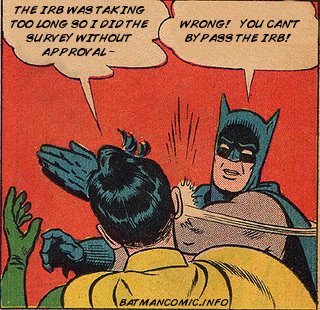
IRB: Your research isn't Research


Image from Southern Fried Science
I'm writing this post in part to procrastinate getting to my 3rd year review packet candidate statement (overwhelming!) and also to share some interesting facts I learned from meeting with IRB on campus to discuss restrictions of my study on effectiveness of digital badges in an IL course for student success.

There was a lot of confusion at first when filling out IRB because we were so low risk, and then had to deal with so many restrictions. Our IRB rep explained that historically, any research involving human subjects needed to come through them, and this was a ton of work for them to handle even if research studies proposed didn't really need to be under their jurisdiction. More recently, "Research" with a capital R has been defined by the federal government as being generalizable (some of this info might be here, though our rep said there isn't one definitive page or site explaining this yet for the general public). This is wholly different from research that is not meant to be generalizable, for example: program evaluations, quality improvement, case studies, etc.

It was funny because after providing the explanation, our rep wanted to backtrack and say that she wasn't implying we aren't doing "research," we just aren't doing "Research." We in fact are doing program evaluation research because we are measuring a specific program at the UA in order to improve the program and will be showing what was successful/problematic for us. We would not be saying our results clearly apply to all IL programs or credit courses across the country. However, if we did want to try to prove that somehow, we would need to stay under their jurisdiction (we have been approved as Exempt level 2 I believe). If we were to stay under IRB, we have to keep them updated on any changes to methods and the form of consent for students, as well as if we were to make any changes in obtaining data. We would also have a ton of restrictions in what we can and cannot access with student info.

Filling out what is the "309 form" here at the UA to essentially rescind our IRB application (I am thrilled to do this, but it's probably not a good idea for me to think about how much time I spent on this for my own sanity) will then move us to program evaluation and we can essentially do whatever we want so long as it's generally ethical and follows FERPA regulations.

With IRB, we would have had to only do an opt-in to our study for students, anonymize data to potentially miss out on seeing trends, and be cautious about asking certain questions in our survey. As program evaluation, we can really gather data any way we want.

My co-researcher made a good point that the basis for Research vs research is in the eye of the beholder (the reader). We won't be saying our research is generalizable, but obviously if someone is reading the article (if we are able to get published, of course), that means they are considering how they might apply our findings to their own program or credit course. It can be very nuanced.

So anyhow, I just wanted to share this. It sounds like it's getting a big push not just on our campus but all over. This conflicts with LIS anxiety over publishing Research, but program evaluation is not any less important. The only distinction is that it does not go through IRB.