Showing posts with label research. Show all posts

October 10, 2013

TMI Instruction and Student Retention

In my Educational Psychology course I'm taking this semester, we were discussing effectiveness of instructor transparency on student motivation. Because people ascribe more positive attributes to others who appear "warm" (rather than "cold"), it seemed like it could be a good thing to be forthcoming with personal information to students. For example, how an instructor had a hard time learning x subject and overcame it, or even addressing if an instructor received negative reviews on TCEs, etc. My opinion was to not show much weakness. You can really hurt your credibility with students who are looking to you as an expert on a topic and the authority figure for the classroom if you try to take yourself down a few notches to be on the same level as them. It sort of makes me think of He's Hip. He's Cool. He's 45! From Kids in the Hall:


Edit: @kellymce pointed out this is another good example (and a much better one, I think!):


Students can sniff out a try-hard. Sometimes I'm tempted to share, particularly when I'm working with student retention-related groups, that I dropped out of college for awhile and also hated using the library and didn't care to ever learn. But I don't! Because I'm supposed to be the authority in the class and I'm in charge. Can you imagine if you went to a therapist and they started telling you about all their psychological issues? Their credibility would be shot, and it would also be very confusing as to why they are sharing this information. As instructors, we are there to teach a particular subject and guide students to learning. We can relate to them in small ways, in a mentor-ish capacity, but emptying out the closet skeletons is not an effective way to motivate or draw students into learning.

Anyhow, these are my thoughts and I realize how strong they are after reading this article that came out today on Inside Higher Ed: TMI from Professors (study indicates role of over-sharing by professors in encouraging uncivil student behavior). Apparently, students are less likely to behave well in class if you try and rap with them (as in the outdated 70s slang for talk/relate to). Check it out, interesting stuff.
"When students reported that their instructors engaged in a lot of sharing about their lives -- particularly stories about past academic mistakes, even stories designed to stress that everyone has difficulty learning some topics -- there is an immediate and negative impact on classroom attitudes."

August 29, 2013

The Pygmalion Effect

I think I've mentioned in previous posts that I'm earning a second masters (MS) in Instructional Design and Educational Technology, but a new update to that is I'm also earning a certificate in motivation + learning environments through the Educational Psychology department to coincide with my degree. My Ed Psych course for this semester is Seminal Readings in Education and Educational Psychology. So, I might blog about either Ed Tech or Ed Psych as I'm going along.

Image from theinsideouteffect.com

Today we discussed some readings we did on the Pygmalion Effect. This is the notion that preconceived expectations for others impact performance or an outcome, so it's the self-fulfilling prophecy. What's interesting is these preconceived expectations have the same effect whether they are self-generated or imposed by an outside source (though, naturalistic expectations are stronger). So, for example, foremen in a warehouse were told certain employees did good or bad on an exam for the job (regardless of how good or bad they actually did), and the foremen rated those employees who they believed to be smarter as better and more efficient. Another study experimented on mice (I am not a fan of this, but...) where mice were either lesioned through lobotomy or made to look like they were so mice handlers could not tell the difference. Handlers were told mice were either bright or dull regardless of lobotomy. Unsurprising is that lesion-free mice with handlers led to believe they were bright performed the best. What was surprising was that lesion-free mice with handlers led to believe they were dull performed just as poorly as lesioned mice who were determined to be dull.

We are looking at this research more directly related to classrooms and formal education next week, but there are huge implications. Visual cues in all of this are one of the most important factors. There is a study in psychology of "thin-slicing" (person perception based on superficial aspects in a short period of time.. so, first impressions, essentially) for student perceptions of teachers, where students watched 30 second clips of teachers teaching with no sound and were to rate their effectiveness as a teacher based on that video clip alone. The study found that the students watching the clips had nearly the same ratings of teachers as the students who actually completed the class and filled out TCEs.
Ambady, N., & Rosenthal, R. (1993). Half a minute: Predicting teacher evaluations from thin slices of nonverbal behavior and physical attractiveness. Journal of Personality and Social Psychology,64(3), 431-441.
Another (and very recent) study by Chia Jung Tsay did something similar where people would receive short clips with no sound of musicians competing in formal events, and they would need to predict who won based on the videos alone, hearing no sound. Accuracy in guessing was astounding, where visual impressions clearly had a greater impact than actual talent. When participants tried to base their ranking guesses on audio alone, they were not able to distinguish who won. Tsay points out that this "suggests that the visual trumps the audio, even in a setting where audio information should matter much more."

In looking at perception-of-self and perception of librarians by patrons, students, faculty, etc., this is important to think about (and something we are examining in the Librarian Wardrobe book). How we are perceived by others might influence how they evaluate us, and how we perceive others might influence how we evaluate them. If visual cues are especially important, then understanding how we present ourselves, whether in gesturing, other physical movements, or clothing, then studying how we dress and public perceptions would be quite significant.

August 10, 2013

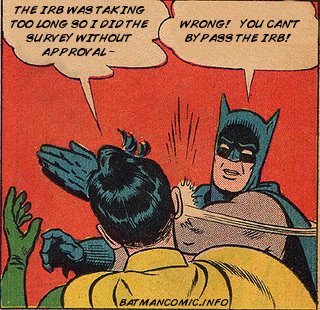
IRB: Your research isn't Research


Image from Southern Fried Science
I'm writing this post in part to procrastinate getting to my 3rd year review packet candidate statement (overwhelming!) and also to share some interesting facts I learned from meeting with IRB on campus to discuss restrictions of my study on effectiveness of digital badges in an IL course for student success.

There was a lot of confusion at first when filling out IRB because we were so low risk, and then had to deal with so many restrictions. Our IRB rep explained that historically, any research involving human subjects needed to come through them, and this was a ton of work for them to handle even if research studies proposed didn't really need to be under their jurisdiction. More recently, "Research" with a capital R has been defined by the federal government as being generalizable (some of this info might be here, though our rep said there isn't one definitive page or site explaining this yet for the general public). This is wholly different from research that is not meant to be generalizable, for example: program evaluations, quality improvement, case studies, etc.

It was funny because after providing the explanation, our rep wanted to backtrack and say that she wasn't implying we aren't doing "research," we just aren't doing "Research." We in fact are doing program evaluation research because we are measuring a specific program at the UA in order to improve the program and will be showing what was successful/problematic for us. We would not be saying our results clearly apply to all IL programs or credit courses across the country. However, if we did want to try to prove that somehow, we would need to stay under their jurisdiction (we have been approved as Exempt level 2 I believe). If we were to stay under IRB, we have to keep them updated on any changes to methods and the form of consent for students, as well as if we were to make any changes in obtaining data. We would also have a ton of restrictions in what we can and cannot access with student info.

Filling out what is the "309 form" here at the UA to essentially rescind our IRB application (I am thrilled to do this, but it's probably not a good idea for me to think about how much time I spent on this for my own sanity) will then move us to program evaluation and we can essentially do whatever we want so long as it's generally ethical and follows FERPA regulations.

With IRB, we would have had to only do an opt-in to our study for students, anonymize data to potentially miss out on seeing trends, and be cautious about asking certain questions in our survey. As program evaluation, we can really gather data any way we want.

My co-researcher made a good point that the basis for Research vs research is in the eye of the beholder (the reader). We won't be saying our research is generalizable, but obviously if someone is reading the article (if we are able to get published, of course), that means they are considering how they might apply our findings to their own program or credit course. It can be very nuanced.

So anyhow, I just wanted to share this. It sounds like it's getting a big push not just on our campus but all over. This conflicts with LIS anxiety over publishing Research, but program evaluation is not any less important. The only distinction is that it does not go through IRB.

December 15, 2010

Using zines as an introduction to library research

I've used my zine lesson plan with 5 humanities classes now and posted the information (including handouts) to my portfolio. This is at an urban community college with many typically under-served students that may have low literacy skills and are pretty brand new to research and libraries.


The purpose from the instructor's perspective is to offer another option for the students to complete a final project; this arts appreciation class is one of the first courses a new student might take at this college. From the librarian's perspective, this is a way to introduce students to how publishing works, give them an opportunity for informal research and creativity. By allowing students to choose any topic relating to art that is of interest to them, it takes some of the pressure off potentially intimidating library resources being explored for the first time. This also falls under critical instruction by talking about whose voices get heard in which platforms and why. Who gets published in a magazine or journal, of course, differs from who might publish a blog or zine.


Many of our students are not familiar with zines, nor blogs. One of their other options for an assignment is to create an autobiographical entry in a blog, so I introduce that mini-lesson first and we talk about what blogs are and how they have evolved (most students have never had their own).

After getting an introduction to electronic self-publishing, I introduce zines but only minimally; I don't want to impose my view of zines before the students get a chance to form their own opinions. I break them up into groups and give each 1 zine, 1 magazine, and a Venn diagram worksheet to compare those items and blogs. After explaining how a Venn diagram works, I allow about 10 minutes for groupwork. After they compare and contrast, we discuss as a class and will look at things like appearance, cost, required knowledge/background, subjects covered, credibility, and publishing processes for differentiation. An interesting point that Jenna Freedman discusses in Zines Are Not Blogs is the digital divide. Students will say that blogs are free as opposed to zines and magazines, but that's not necessarily the case. One must have computer and internet access to read a blog, as well as at least *some* computer literacy to create a blog. If there is not a school or library nearby, an individual would be required to pay for computer/internet at home, and that is not free. This is an interesting perspective on where zines and blogs differ; there are people who believe zines are dead and why make a zine when you could just make a blog, but there are still people out there who don't have access to the tools required to read/create the electronic version of self-publishing.

After the discussion, I explain they will be making a mini-zine (1 piece of paper turned into an 8 page zine). They can choose any topic (as I mention above) as long as it relates somehow to the arts. It can be any style they want: typed, drawn, comic, collage, handwritten; they just need to include at least 2 sources in a citation from any library database. I demonstrate how to use one of our most user-friendly databases (Student Research Center) and then show them how to cite a source in the citation management software our library uses, NoodleTools.

I tell the students if they are going to make a zine, it's only fair if I make one too, in exchange (I am looking to collect student zines after grading to display in the library). After using sample search terms for yarn bombing (knit graffiti), I show them my final product so they can get a sense of the assignment from start to finish.

This has been a successful IL session so far and I am in the process of collecting zines from Fall semester and will be getting more from Winter term students! You can have access to learning objectives, the lesson plan, and handouts from my portfolio.

September 29, 2010

Kuhlthau, Second Life, and Beach Jupiter

All throughout library school I heard about Second Life, how exciting it was and how it could have educational benefits; I thought eh ok that's great for people who like that sort of stuff, and I'm willing to acknowledge its possible potential, but I wouldn't want to try it.

But the other day, I saw on the ili-l discussion list that the iSchool at Sheffield University was going to start a journal club in Second Life to talk about articles relating to information literacy instruction. After attending less interactive webinars more recently I thought maybe a visually-oriented, interactive web meeting would be more intriguing. I decided to just give Second Life a shot and thought I could attend the session while at our quieter, satellite campus.

To set myself up, I created an avatar and tried to get comfortable with the program (you need to download the browser to your computer (it's free)). Making my avatar look how I had sort of hoped was very awkward and seemed janky to me, but I feel like it's good enough -- she is no longer bald and wearing both a skirt and pants at the same time. Walking, running, and flying aren't as tedious as I had thought they would be, and for the most part, I think I get the basic functions.

The article we discussed in the session was:
Kuhlthau, C. C., Heinström, J. & Todd, R. J. (2008) "The 'information search process' revisited: Is the model still useful?." Information Research [ejournal], 13(4), paper 335. [Available at http://InformationR.net/ir/13-4/paper355.html]

Organized by "Sheila Yoshikawa" and with the discussion led by "Pancha Enzyme," which are Second Life handles of course, it was a smooth session with a lively discussion (my avatar's name is "Beach Jupiter"). It felt more interactive than a standard webinar, and granted it was meant to be a group discussion rather than a presentation, the visuals certainly made me feel more inclined to participate than an anonymous chatbox.

I'll summarize what I took away from the discussion, but won't spend too much time on summarizing the article itself since it's easy to access:

First, Pancha gave an overview of the article we read to reiterate the main points:
  • it covers knowledge construction and feelings in information seeking
  • the article showed it is still relevant today, changing for the information environment (technology)
  • the method can be diagnostic in figuring out point-of-need to assist students struggling with assimilating information
  • it offers recognition of discouraging and motivational emotions in the research process
 (And I will add, from the article, the six steps of the information search process are, in order:
  1. initiation
  2. selection
  3. exploration
  4. formulation
  5. collection
  6. presentation)
She also had slides ready that avatars could zoom in on to read closely and projected SCONUL's 7 Pillars of Information Literacy and Taylor's Learning Process Sequence (see section 3.1.3) for comparisons. We discussed that Taylor's process seems to offer more room for emotions (as opposed to SCONUL's pillars), and that it also focuses on the experience of learning.


We talked about strengths and weaknesses in the article as well:
Weaknesses first:
  • article illustrates research process as linear, when it truly is not
  • students could not describe their own emotions; they had to rate pre-chosen terms
  • confidence intervals were small (for emotions)
  • much information now comes from browsing and encountering (not just searching), so is the article still fully relevant today with the expanse of technology?
  • individuals have different emotions when there is no grade involved (or money/time constraints for non-students)
  • seems prescriptive: those who follow the process of this emotional rollercoaster during research will not be as successful, as it says the students who followed the process more closely did the best grade-wise and with learning
Strengths
  • could be used as a marketing tool for libraries to appeal for more student/class time
  • can use the process to show students that their frustrations and anxiety (as well as other negative emotions) are very common and do not represent a sign of failure
  • could be used as a guide to time management
  • (should be explicit for learners and not a secret guide for librarians/teachers)

They are looking for discussion leaders in future sessions, as well as articles to recommend. Seems like a great thing to keep up with, and I will be attending sessions as I am able.