Showing posts with label professional development. Show all posts

March 31, 2015

#acrl2015 reflection: experiences of academic librarians of color

Before #acrl2015 might become a blur, I wanted to reflect on the conference, and one session in particular, From the Individual to the Institution: Exploring the Experiences of Academic Librarians of Color with panelists Juleah Swanson, Isabel Gonzalez-Smith, Azusa Tanaka, Ione Damasco, Dracine Hodges, Todd Honma, and Isabel Espinal. You can find the Storify from the session here. I'm parsing my ideas together still, so apologies if this is a little messy...

One of the main takeaways from this session for me was that we need to stop framing diversity as a problem that needs to be solved, and that diversity is everyone's responsibility. This drives home the point for me even further that diversity and inclusivity research and other work should be woven into, and encouraged in, day-to-day work as well as in the tenure and promotion process. Something I wrote about over the summer was related to hiring for diversity and this panel made me think even more about the burden of responsibility we put on those who are diverse to do this work. We should all be doing this work, we should be doing this research as tied to our "regular" work. As Isabel Gonzalez-Smith noted during the panel, our students' diversity is skyrocketing, but diversity of librarians is crawling along at 0.5%. Why is that? If we're concerned with how people use our resources, how we do instruction, and the value of the library, shouldn't we be spending as much time on figuring out why we haven't been able to improve our diversity and how that affects our field and our constituents? I feel like I might still be framing it as a problem here, and it's a hard rhetoric to get away from, something that many of us could probably change our perspective on.

The other thing this panel made me realize is how we talk about diversity in regards to "types" of diversity. When we say we need "all types" of diversity equally, that brings to mind the conversation around #BlackLivesMatter vs #AllLivesMatter. It's this misconception that "colorblindness" affects positive change by imagining everyone as the same, when it winds up being detrimental by not acknowledging specific, very problematic issues. Here is a tweet for some context:


If we don't focus in on specific diversity and instead just lump it all together, we can't really address what we are lacking and what needs to change. And just saying finding people with "different viewpoints" is equivalent to diversity that speaks to systemic structures, such as racism, classism, sexism, etc. is problematic, particularly if these people with different viewpoints also happen to always be white males or white middle class white women. Of course, finding people with different perspectives is important, but it doesn't stand in for addressing other issues surrounding diversity.

The other thing we should be taking about is that diversity isn't a numbers game. Filling all the lower-level positions with diverse candidates still doesn't address who holds the power. There is a highly skewed percentage toward white men holding administrative positions, so even if we get the "right" number of diverse candidates, how does that change the culture?

And the last thing I want to touch on from this panel that really made me think was the idea of "institutional fit" that a couple panelists brought up. The fact that this nebulous idea of fit when we're looking for candidates can harm our moves toward diversity by discounting certain people who we don't feel are like us. And we can say that we really don't do that, but when we think of fit it winds up being people we get along with, or people who have a similar mindset to the institutional mindset already in place. It can reinforce hegemonic structures.

So I think we have a ways to go, but it's so heartening to see more critical sessions accepted at ACRL and that there is a bigger interest in talking about these things. I'm certainly still learning and thinking about what privilege I have, but I hope we can have these larger discussions with our institutions and as a profession.

--Check out the session link above for their list of resources / bibliography, and also see Gonzalez-Smith, Swanson, and Tanaka's chapter in The Librarian Stereotype: Desconstructing Perceptions and Presentations of Information Work. The Pho & Masland chapter might be of interest as well.

September 14, 2014

Instruction bootcamp training: Faculty collaboration!

The last few months have been a whirlwind! We officially started our reorganization at the UA Libraries over the summer and have been getting situated in our new roles since. Before, our teams were functional, so we had an instruction team, a collections and research services team, etc. Now our departments are based on cross-functional areas that require more collaboration. My department is a combining of what was previously the instruction team and the collections + research team since we are following a subject liaison model for campus. With this merging, those in our department with expertise are training others. I helped organize an instruction bootcamp training for back in August where I covered the new ACRL Information Literacy Framework, some basic instruction concepts, and the process of curriculum mapping since we will be working toward mapping all programs (or as many as we are able to).

I was so happy that @susanarcham was willing to let me take a look at her curriculum mapping training materials that they used at Loyola Marymount in LA, and I found a lot of great stuff that I was able to adapt for my colleagues. One of the most useful activities that I wanted to share my adaptation of was helping librarians think about faculty collaboration from our new roles as liaisons. I added in some fun characters and scenarios and thought this activity might be useful for others doing instruction and heavy campus outreach. This is following the theme of "Mission Impossible" that Susan created. My department really liked this one.

Here is a snippet of one of the faculty profiles below. I divided everyone into subject-based groups to brainstorm and role play (sciences, business, social sciences, arts and architecture, humanities), and then we all discussed as a full group.

Find the full activity with all characters and discussion questions here.


I hope to share the rest of our training materials from the bootcamp if I have more time to blog about this. Otherwise, the next month is going to be focused on the Connected Courses class I'm taking, as well as the ALA Instructional Design Essentials ecourse that I'm teaching with Erica DeFrain.

April 3, 2014

Introducing #critlib chats!

Tuesday night marked the first #critlib chat we had on Twitter to talk about critical pedagogy in libraries. Myself and the awesome @barnlib, @catladylib, @edrabinski, and @kellymce  organized the chat, and I served as moderator for this week. I'm really excited that these are happening, because not only is it important to talk about this stuff, but selfishly, I've been really wanting there to be something like this for awhile.

We created a cheat sheet for the chats to provide information about upcoming topics, how the chats work, and then to post the questions in real time as a reference point beyond the constantly updating Twitter hashtag feed. It's pretty fast paced to do these Twitter chats, and can make having in-depth conversations difficult, but it is a good entry point, is fairly accessible, and open to all. We had a good amount of people participating and some excellent conversations going. It's helpful to have 3 tabs open for this: the cheat sheet, the hashtag feed on Twitter, and then your own notifications feed to make it easy to reply to people without losing #critlib. Thanks to @aszingarelli, we also now have a Storify you can check out to see how the conversation went.

For this first meeting, we mostly talked about definitions. What is critical pedagogy, and what is critical library pedagogy? How do you incorporate critical pedagogy in your library instruction and in other aspects of library work? It was a good first meeting to establish a somewhat common understanding, and provide more context for those who are interested but don't feel comfortable participating yet. Some people mentioned they were just going to lurk, and I think that's great there is so much interest. I hope the chat will make everyone more comfortable sharing their thoughts, it's not meant to be a judgmental place or where anyone assumes they're an expert.

We posted Gregory & Higgins' intro to Information Literacy and Social Justice as supplemental reading since they introduce the concept very well. I was reading Toni Samek's foreword to the book as well, and thought what she said about risk was important:
We should not underestimate the collective will of projects like this one. Each contributor should be thanked for the risk they take on the page. I have, on a number of occasions, said publicly that information literacy is far too often realized in service of the state. This is rarely a popular observation. (And so I have been told.) But for almost twenty full years I have worked under the protection of my right and responsibility of academic freedom. The same cannot be said for all of the seventeen chapter contributors to this work. I admire them for their conviction (2013, vii).
This is important to think about, as these might not be popular opinions. It is somewhat of a risk to discuss these things, particularly for those who are not in tenured positions. So it's great to have a place to chat to support others with these similar convictions. We hope more will join us next time. Tuesday, April 7th will be the second #critlib, and then we will be moving to every other week after that.

Also see our Zotero group with further resources and readings (some of these might wind up being readings for future chats).

January 17, 2012

Reflections on Code Academy and Code Year so far


I've started Code Academy and as of last night, completed Week 1. This is a free program with weekly, online lessons to learn how to code (Javascript). Librarians have started using the hashtag, #codeyear to communicate with each other on their progress (and you can sign up for the lessons at the Code Year site). There has been a push in Libraryland for librarians to learn coding so we can be more self-sufficient in developing digital services and products, as well as just communicating better with IT professionals. There is even a newly-established ALA Connect group for librarians to discuss and help each other with the weekly lessons.

My impressions so far of Code Academy are mixed. Of course, no doubt, this is a great thing. It's free, it's accessible, and it's an intro-level program that is incredibly interactive. It can be hard to teach yourself these types of skills, so opening up the playing field is huge.

It's also nice that the lessons are given in increments, so you get Week 1 for a week, and then are sent Week 2 the next week. You can do more if there is more content up on the site, but it at least makes it more digestible. The leveling up and getting badges is another thing I like. It could be a little bit of gamification, but since these lessons have been made more social through Code Academy and also through the library community, it adds a little more fun to it. I've taken a particular interest as well as to how the Mozilla Open Badges project will relate to library instruction (or could relate), so experiencing a badge-generating program is useful to me and I'm seeing how it could potentially work with students. Although the Mozilla Open Badges project is for open access education, I still think it could be a beneficial concept to try in university and other formal academic settings as well.

Back to Code Academy, there are also some things that I am finding problematic. When considering good pedagogy, detailed feedback contributes to effective learning. Code Academy does not really give any feedback. You put your code in and run it, and then you are right or wrong. There is a little bit of info that pops up when you do enter wrong code, but it's not often enough to help you figure out where you went wrong. The hints are great at the beginning of the lessons, but get more obtuse and mysterious as you progress. I think it can be a good method that they are giving sort of a sandbox atmosphere to try out coding without being bogged down with theory and memorizing definitions (and where you don't have to be afraid of failure, which is a quality of a good game BTW) but at the same time, not really understanding the logic behind how some of the code works makes it very hard to understand why your answer does not work. I was glad to have other librarians who understand coding logic explain why my answer for Week 1, Lesson 8.2 was incorrect, so I was able to progress and finish the week.

Overall, I really do think Code Academy is great, and I'm going to continue on with the lessons. It can be difficult to weave detailed feedback in to an automatic, teach yourself-type program, but at the same time, it is essential for people who are just starting out. I think this article by Tech Crunch, "Will we need teachers or algorithms" (interesting read also for emerging trends in education) rings true here to a degree. Human or AI-driven though, if you can't figure out what you did wrong in a meaningful way, you can't learn from your mistakes and progress.

July 25, 2011

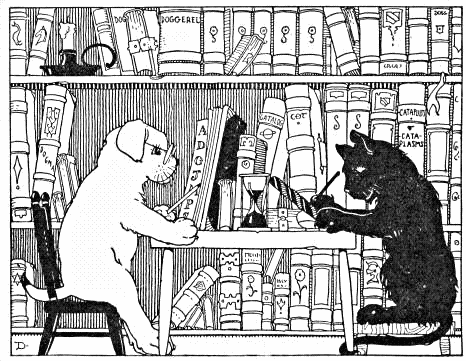
Make it happen with mentorship

http://www.wpclipart.com/education/reading/reading_2/cat_and_dog_in_library.png
After asking a librarian friend for his opinion on something, I got thinking about the importance of having mentors and a support network. Starting out as a new librarian can feel pretty chaotic at first, whether it's navigating a job search, navigating a new job, or getting more involved in professional associations and publishing. From what I've noticed, it seems librarians with more experience are often pretty open to mentoring a new librarian, but you don't want to just assume that anyone is willing to be a mentor. Some workplaces have formal mentorship programs in place, where others have nothing of the sort and you are essentially on your own. In either situation, it's still really beneficial to have a connection with an outside mentor. And if possible, not just one mentor, but mentors.

I feel like I've been extremely fortunate in my friends and contacts where I have someone(s) to turn to when I'm unsure of something, stressed out, or just have some good libraryland-related news to share that my non-librarian friends might not understand what the big deal is. A mentor doesn't have to be a great deal older than you to be effective: my ACRL Instruction Section mentor is only a few years older than me, but she can really relate to questions I ask and has a specific interest in early career issues. That's not to say a librarian with a decade or more of experience would be any less helpful: another mentor I have from when I was in library school is always supportive when I need some guidance and has scads of great advice to offer. Some of my mentors I don't even consider formal mentors, but I've admired them in some way or another, gotten to know them, and feel comfortable asking their opinion. It's invaluable to have a variety of perspectives as you make your way through your career.

One thing I was worried about when signing up for a formal mentorship program was that I didn't want the relationship to be all one-sided... I didn't want to feel like I was just taking and not giving anything back; but I do know in sharing experiences, and also offering a confidential ear, a mentoring relationship can certainly be useful to both parties.

If you're not sure where to start in finding a mentor, try looking at the associations you have membership in and see which offer mentorship programs; ALA Connect also has an option for your profile to add you to the mentoring community. If still in school, you can see if there is any faculty mentoring available or find a librarian on campus you can talk with. Being brand new doesn't have to be a scary thing, and even librarians with more experience seem to have mentors throughout their whole career. Building a great support network will get you through confusing times and build you up when there are exciting things to share.

July 6, 2011

ALA 2011 reflections

After getting caught up with everything after ALA 2011, I now have a chance to reflect on the conference. There are some other excellent reflection posts recently done by Aaron Tay and Andromeda Yelton, and Patrick Sweeney has some inspiring vlogs up on his YouTube channel. This was one of the best conferences I've ever experienced (not that I've been to a whole lot, but still). Being more involved in programs, and meeting and reconnecting with a ton of great people really made the conference experience; it helped that stale professional development advice come to life, where I realized oh wait, I was just networking or wow, I just stepped outside of my comfort zone.

If I were looking back to my (student) self in 2008 who attended ALA Annual in Anaheim, here is some advice I would give myself:
  1. Get involved: apply for special programs (like Emerging Leaders), participate on panels, contribute to unconferences, plan a party or event, make/do something. Being an Emerging Leader this year, as well as being on REFORMA's How I Landed My First Librarian Job and What I Did 'in Between' panel were not only just good experiences to have, but gave me even more interesting things to talk to people about. (By the way, the REFORMA panel will be available as a free webinar in October if you missed it and would like to catch it next time.)
  2. Don't play hard to get: I officially met some people that I've been following online for awhile and felt kind of fangirl-ish when the opportunity arose to connect with them in person. Believe it or not, people actually like compliments! It might feel awkward and stalkerish to say, "Oh yeah I [read your blog] or [noticed your work on x committee] or [love your stylish outfits] or [etc] and I think you're great!" But if it's the truth, and you're not actually a stalker, it's always nice to make people feel good about themselves, and hey you started a conversation.
  3. You know more than you think: Just because you're not an expert in such and such librarianship with 10+ years of experience doesn't mean you have nothing to contribute. Look at Hack Library School and all they're doing, it's fantastic! I love reading Bohyun Kim's blog where she talks about early career issues and what she is learning along the way. 8bit Library / #MIH has found a niche and are known for what they write and create about videogames in libraries. In fact, JP and Justin were my Emerging Leaders team mentors, and now that our group has done this project we also have contributed a lot to the topic -- and two of us will be continuing on with more research that we're very excited about.
  4. Other suggestions I can't take full credit for: From the Emerging Leaders session, it was reiterated by Peter Bromberg, Maureen Sullivan, and other ELs in our group discussion to think of librarianship as a gift culture (be generous), volunteer for things (say you'll do something and do it, committees and others will be pleased), and always have a drink in your hand (open body language + interest in talking to others = ability to make friends).
Last I'd say, as networking is really a big part of conferences, to not think of it as networking. It is what it is, but I really just thought about it as making new friends and talking to interesting people. Librarians and other info professionals are often fun to talk to; just strike up a conversation, and if you keep those other suggestions in mind, you'll have a lot more to talk about (less awkward is always good, right?).

January 13, 2011

Takeaways from ALA MW 11 Emerging Leaders Session

ALA Midwinter 2011... wow. This was my second ALA conference, the first being an Annual while I was still a student. What a huge difference. My main impetus for going was that I was accepted to the 2011 Emerging Leaders class this year; I  feel like it's a great experience so far.

Before starting the program, I read some of the criticism out there to get an idea of what I'd be in for and what to be cautious of. Kim Leeder wrote a great article at In the Library with the Lead Pipe: All Dressed Up with Nowhere to Go: A Survey of ALA Emerging Leaders , where much of the problem sounded like unmet expectations of the day-long program itself, as well as the reach and scope of the projects. I have to say those involved in the program really listened to former EL class concerns, because some of these issues were addressed, and some changes were clearly made. And I am very excited about the project I am working on, which is creating a collection development policy for videogames in libraries. I think this project will not only be interesting and even fun, but have a lot of reach, too.

We got some fantastic information on leadership from Maureen Sullivan, Peter Bromberg, Leslie Burger, and Keith Fiels. Andromeda Yelton, another Emerging Leader, has a great write up of what we learned on her blog:

The main takeaways, as Andromeda notes, are:
  1. Be scared everyday (and have a drink in your hand)
  2. Be generous
  3. There is no spoon
  4. Relationships
This all really relates back to all the brainstorming we did on good leadership qualities. What works well for us, and what positive attributes we find in those at the top. A big theme that stood out for me is creating buy in. You have to foster relationships with those around you to get anything done; we were told at the session that the reason we were all meeting face-to-face early on was so we could be friends first to be better able to work together in our groups. On creating buy-in, you must also trust in others, which includes being generous enough to offer others opportunities and not micromanage. Working to make ALA yours (or any situation yours) takes effort, and it's true: there is no spoon. As my EL groupmate, Abby Johnson, says in her blog, "ALA is not your mom." If you're not scared everyday (or even almost everyday), what's the point? Trusting in others is a leap, as is trusting in yourself in new, uncomfortable situations. As I commented in Andromeda's blog, I'll often say yes to things before I even have a chance to be nervous. You can always be nervous, but you won't always have a chance to say yes to some of these amazing opportunities.

A couple people were asking me at the conference what I think of the program so far since they were considering applying next year -- at this point in time, I say two thumbs up.

September 29, 2010

Kuhlthau, Second Life, and Beach Jupiter

All throughout library school I heard about Second Life, how exciting it was and how it could have educational benefits; I thought eh ok that's great for people who like that sort of stuff, and I'm willing to acknowledge its possible potential, but I wouldn't want to try it.

But the other day, I saw on the ili-l discussion list that the iSchool at Sheffield University was going to start a journal club in Second Life to talk about articles relating to information literacy instruction. After attending less interactive webinars more recently I thought maybe a visually-oriented, interactive web meeting would be more intriguing. I decided to just give Second Life a shot and thought I could attend the session while at our quieter, satellite campus.

To set myself up, I created an avatar and tried to get comfortable with the program (you need to download the browser to your computer (it's free)). Making my avatar look how I had sort of hoped was very awkward and seemed janky to me, but I feel like it's good enough -- she is no longer bald and wearing both a skirt and pants at the same time. Walking, running, and flying aren't as tedious as I had thought they would be, and for the most part, I think I get the basic functions.

The article we discussed in the session was:
Kuhlthau, C. C., Heinström, J. & Todd, R. J. (2008) "The 'information search process' revisited: Is the model still useful?." Information Research [ejournal], 13(4), paper 335. [Available at http://InformationR.net/ir/13-4/paper355.html]

Organized by "Sheila Yoshikawa" and with the discussion led by "Pancha Enzyme," which are Second Life handles of course, it was a smooth session with a lively discussion (my avatar's name is "Beach Jupiter"). It felt more interactive than a standard webinar, and granted it was meant to be a group discussion rather than a presentation, the visuals certainly made me feel more inclined to participate than an anonymous chatbox.

I'll summarize what I took away from the discussion, but won't spend too much time on summarizing the article itself since it's easy to access:

First, Pancha gave an overview of the article we read to reiterate the main points:
  • it covers knowledge construction and feelings in information seeking
  • the article showed it is still relevant today, changing for the information environment (technology)
  • the method can be diagnostic in figuring out point-of-need to assist students struggling with assimilating information
  • it offers recognition of discouraging and motivational emotions in the research process
 (And I will add, from the article, the six steps of the information search process are, in order:
  1. initiation
  2. selection
  3. exploration
  4. formulation
  5. collection
  6. presentation)
She also had slides ready that avatars could zoom in on to read closely and projected SCONUL's 7 Pillars of Information Literacy and Taylor's Learning Process Sequence (see section 3.1.3) for comparisons. We discussed that Taylor's process seems to offer more room for emotions (as opposed to SCONUL's pillars), and that it also focuses on the experience of learning.


We talked about strengths and weaknesses in the article as well:
Weaknesses first:
  • article illustrates research process as linear, when it truly is not
  • students could not describe their own emotions; they had to rate pre-chosen terms
  • confidence intervals were small (for emotions)
  • much information now comes from browsing and encountering (not just searching), so is the article still fully relevant today with the expanse of technology?
  • individuals have different emotions when there is no grade involved (or money/time constraints for non-students)
  • seems prescriptive: those who follow the process of this emotional rollercoaster during research will not be as successful, as it says the students who followed the process more closely did the best grade-wise and with learning
Strengths: 
  • could be used as a marketing tool for libraries to appeal for more student/class time
  • can use the process to show students that their frustrations and anxiety (as well as other negative emotions) are very common and do not represent a sign of failure
  • could be used as a guide to time management
  • (should be explicit for learners and not a secret guide for librarians/teachers)

They are looking for discussion leaders in future sessions, as well as articles to recommend. Seems like a great thing to keep up with, and I will be attending sessions as I am able.

March 18, 2010

Somewhere in Texas by the yellow sand

I am happy to announce I have recently accepted a job offer in Texas with a community college and will be moving from Tucson next month. I informed friends of this more privately on Facebook and otherwise wanted to wait until I received the official letter of offer, but I'm so excited, I just had to share. I will be doing instruction, reference, and collection development.

Officially, it took me 9 months to find a position I feel is a good match for my background and interests, as well as being in a location that would be able to mesh with my lifestyle. I also needed to keep in mind that my partner would need opportunities to find work, and since he's involved in art, we would need a bigger city.

I really enjoyed the position I've had while searching, and am so happy I had such an excellent supervisor who was also a mentor to me. Unfortunately, the position is unable to be full time and permanent, and there is not really any room to progress.

From being able to work while I searched, I was able to be picky, and I certainly do not take that luxury for granted. My success rate with interviews was pretty good, and now that I do officially have a position, I hope to pass on some advice to new librarians looking for work:


-While in school-


Take full advantage of *everything* your program has to offer. I went into my program with no official library experience, so I was anxious about doing as much as absolutely possible before graduating to give me the background and skill set I would need. Join and participate in numerous student groups and/or get involved in community service projects through other library professional organizations. Go to conferences if you can, take online webinars, go to lectures and resume-writing workshops, etc. Taking an internship or practicum in my program was optional, but I think it should be mandatory -- getting that work experience, mentoring, and potential recommendations is incredibly helpful. The more experience you have, the more opportunities you will have. The following scene from The Secret of My Success is unfortunate but true:
Unnamed employer: I'm sorry, Mr. Foster. We need someone with experience.
Brantley Foster: But how can I get any experience until I get a job that GIVES me experience?
Unnamed employer: If we gave you a job just to give you experience, you'd take that experience and get a better job. Then that experience would benefit someone else.
Brantley Foster: Yeah, but I was trained in college to handle a job like this, so in a sense I already have experience.
Unnamed employer: What you've got is college experience, not the practical, hard-nosed business experience we're looking for. If you'd joined our training program out of high-school, you'd be qualified for this job now.
Brantley Foster: Then why did I go to college?
Unnamed employer: [laughs] Had fun, didn't you?


-During and after school-


Having a professional website and other, electronic means to showcase your "personal brand" is so helpful. Employers have so many candidates to look through now with the economy being the way it is, that the more you can present about yourself and the easier you make it for them to decide if they're interested or not, the better your chances are. I put up a professional portfolio, created this blog, and started a Twitter account. This way, you are able to keep current in the field, and also make it clear how you are interested in contributing to the discourse. Instead of just saying "I'm a great communicator," the hiring committee can also actually see your communication skills in practice. Keeping up with blogs and Twitter feeds makes it much easier to have intelligent answers for tougher interview questions.

It's also useful to install a stat counter or analytics code on your sites if possible. You can see if your information is effective, and also determine what specific pages or files interest a potential employer to know what to focus on more during the interview. I remember for one interview, through my site statistics, I noticed an employer had viewed all of the tutorials I created, so I knew that was of importance to them and was able to discuss that further.

I also kept a spreadsheet of my applications, listing the employer, the position, location, deadline, date I applied, how I applied, and then any notes. When I would get an interview, I would color code that row orange for phone interview, yellow for in-person interview, and then green for job offer or acceptance into employment pool; red was then for rejections after interviews. I found this so helpful to keep track as well as knowing when to follow up.

-While applying-


A favorite instructor of mine from my program told me that you should apply to as many jobs as possible that you think you might be interested in because hiring committees sometimes talk in libraryland; if you're in a lot of candidate pools at various institutions, other institutions might find you even more appealing.

If you aren't able to have a library-related job while searching, then volunteer! Even if it's only a couple hours a week, it shows that you are committed to gaining experience. You could also sign up to be a mentee or do something with your alumni association.

And of course, be aware of what you're putting out there about yourself. I cringe a little when I see soon-to-be librarians cursing and speaking negatively of classmates in their public profiles, because you know most potential employers will look you up. Of course everyone has conflicts and can get stressed, but publicly displaying your grievances about your colleagues doesn't always go over so well, unless you're the Annoyed Librarian and get paid to make people feel better about themselves by tearing others down (was that hypocritical heh).

At the same time, don't hide who you are, because you don't want an employer to think you are one way, and then you might feel like you can't be yourself once you get the job.


Despite being stressful and unsure if there was a (happy) end in sight, I feel like I have really learned a lot about how employment in libraryland works. Hopefully this advice is found useful. If anyone else has tips, please do share in the comments.

November 21, 2009

Event planning & promotions presentation for PLG-UA LIS Skillshare

I presented this on Tuesday, November 17th at the Progressive Librarians Guild - UA Chapter LIS Skillshare.

I have about 8 years or maybe a little more of event planning experience (including outreach/promo/marketing/pr), so I thought I would share my accumulation of skills. Since I've done educational events, festivals, music shows, library student group workshops and a symposium, community social events, and fundraiser events, I wanted to capture all event types for the attendees, but of course all the information could be relatable to libraries (public, academic, or otherwise).