November 14, 2010

Librarian Wardrobe

I had an idea awhile back before I moved about starting a blog about what librarians wear to work. After mentioning it to a few people on Facebook, I decided to not bother since no one really seemed interested in participating; but then recently saw A View From Your Desk, which is a user-submitted blog about the view from a librarian's desk (and even contributed) and it reminded me of my blog idea. 

So, I've now created a new blog about what librarians wear to work: Librarian Wardrobe. Anyone can submit an image, and it could be the submitter wearing the outfit, parts of the outfit on a hanger, or whatever combination works.


It will be interesting to see how dress codes vary at different kinds of libraries and for different kinds of positions. When I was starting my job search during/after library school, I was wondering myself what exactly is appropriate since there seems to be a lot of variation, so maybe this will be useful to new librarians as well.

November 5, 2010

Taught to teach

Credit: melodi2 from morguefile.com
Last month, myself and another recent graduate from my program were invited to a favorite instructor's academic libraries class to talk about our experiences as new librarians. The class being in Arizona, my friend in Mississippi, and myself in Texas made it a virtual session in Elluminate.

I'm still exploring my instruction style as I get used to my position, the college, and the programs, but after 6 months now, I do feel much more comfortable. One of the students in the SIRLS class asked a question probably on many soon-to-be and new librarians' minds: how do you learn how to teach?

I personally tried to get as much experience as possible at least just making presentations while in library school. For my internship, I took initiative and worked with my supervisor to get instruction into my responsibilities. This did not bring me anywhere near a pro, but I was able to do some library orientations for a summer internship program.

After that, I just read. Read, read, read. Anything I could find that talked about instruction methods or library instruction. Books, magazines, blogs, you name it. I'm still working through the reading list I keep for myself. When I started my job, I asked for reading suggestions from my supervisor and even had the chance to read through all her collected teaching materials from over the years. I asked to watch other librarians teach and am hoping to get in some classes to watch experienced instructors as well. Of course I remember what I liked and didn't like while a student myself, but seeing the classes from a different perspective will be really useful.

I'm still figuring out assessment and outcomes, as well as tailoring instruction to our students specifically. Being a community college, we have a wide range of demographics, skill levels, and interests.

I've found I am the most successful with teaching when I do doubt myself a little because I feel like it puts me on the same wavelength as the students: I'm a little unsure about teaching and they're a little unsure about research, but we can connect there. I try to just have a conversation with them as much as possible; at the same time, I try to say in the mindset of hey I'm going to show you some neat technology and tricks.

Anyhow, here is my (work in progress) list for figuring out how to teach. If there are more suggestions out there, please leave them in the comments; I do have to say much of the library literature on teaching ignores showing how to write an actual lesson plan, which is frustrating, but nonetheless:

Books

  • Made to Stick (Chip and Dan Heath) - How to make ideas stick in presentations/ads, and of course in teaching. They give many real-world examples and offer a handy acronym to aid in composing these sticky messages using their suggestions.
  • Critical Library Instruction (Emily Drabinski, Alana Kumbier, and Maria Accardi, eds.) - Essays on the "banking model of education" described by Freire, and finding other, progressive methods to teach students using involvement, real world scenarios, and teacher as student/student as teacher. Many of these were inspiring and made me excited to work some of the ideas into my teaching.
  • Library Instruction Cookbook (Ryan Sittler and Douglas Cook) - Cookbook-themed ideas on instruction activities (mostly for one-shot classes); many really applied to 4yr academic institutions so weren't as helpful for me, but certainly have a list of about 10 ideas I might be able to use or tweak
  • Teaching Information Literacy: 35 Practical, Standards-Based Exercises for College Students (Joanna M. Burkhardt, Mary C. Macdonald, and Andre J. Rathemacher) - A little dry, but does help in better understanding the ACRL Standards and how to apply those to teaching
  • Information Literacy Instruction: Theory and Practice, 2nd ed. ( - New edition of textbook, have not gotten to yet
  • Mckeachie's Teaching Tips: Strategy, Research, and Theory for College and University Teachers (Wilbert McKeachie and Marilla Svinicki) - Seems to be a standard for college instructors, most not receiving formal education on exactly *how* to teach. A good amount of the book felt irrelevant to libraries, unfortunately, but did pick up some good tips by skipping around.
  • Teaching Librarians to Teach: On the Job Training for Bibliographic Instruction Librarians (Clark and Jones) - This book is old, like 1980s old. I read it the month I was graduating library school and can't remember much... I think I did find parts of it helpful for a start in learning library instruction, but might not be the best one out there...
  • Motivating Students in Information Literacy Classes (Trudi Jacobson and Lijuan Xu) - Good overview in getting students engaged through assessment.
  • The Invisible Web in Learning and Teaching (Jane Devine and Francine Egger-Sider) - This book wasn't really specifically about teaching, but had some good ideas for helping students grasp the deep web.
  • New Librarian, New Job: Practical Advice for Managing the Transition (Tucker Cory and Reeta Sinha) - Again, not specifically geared to teaching, but did help understand the role of library instruction and information literacy within a position description and general expectations.
  • Ideas for Librarians Who Teach: With Ideas for Teachers and Business Presenters (Naomi Lederer) - Perfect for skimming; sound bites of ideas.
  • Public Speaking Handbook for Librarians and Information Professionals (Sarah R. Statz) - Helpful tips for public speaking and presenting (of course can directly help with teaching), and finally a book on public speaking geared to librarians who, let's be honest, aren't always the most outgoing bunch.

Blogs/Magazines/Journals/Specific Articles
I'm just going to post a link to my del.icio.us -- I have over 60 pages and articles tagged as instruction. Some are from librarians and library organizations, some from other educators. I add to this list regularly.

September 29, 2010

Kuhlthau, Second Life, and Beach Jupiter

All throughout library school I heard about Second Life, how exciting it was and how it could have educational benefits; I thought eh ok that's great for people who like that sort of stuff, and I'm willing to acknowledge its possible potential, but I wouldn't want to try it.

But the other day, I saw on the ili-l discussion list that the iSchool at Sheffield University was going to start a journal club in Second Life to talk about articles relating to information literacy instruction. After attending less interactive webinars more recently I thought maybe a visually-oriented, interactive web meeting would be more intriguing. I decided to just give Second Life a shot and thought I could attend the session while at our quieter, satellite campus.

To set myself up, I created an avatar and tried to get comfortable with the program (you need to download the browser to your computer (it's free)). Making my avatar look how I had sort of hoped was very awkward and seemed janky to me, but I feel like it's good enough -- she is no longer bald and wearing both a skirt and pants at the same time. Walking, running, and flying aren't as tedious as I had thought they would be, and for the most part, I think I get the basic functions.

The article we discussed in the session was:
Kuhlthau, C. C., Heinström, J. & Todd, R. J. (2008) "The 'information search process' revisited: Is the model still useful?." Information Research [ejournal], 13(4), paper 335. [Available at http://InformationR.net/ir/13-4/paper355.html]

Organized by "Sheila Yoshikawa" and with the discussion led by "Pancha Enzyme," which are Second Life handles of course, it was a smooth session with a lively discussion (my avatar's name is "Beach Jupiter"). It felt more interactive than a standard webinar, and granted it was meant to be a group discussion rather than a presentation, the visuals certainly made me feel more inclined to participate than an anonymous chatbox.

I'll summarize what I took away from the discussion, but won't spend too much time on summarizing the article itself since it's easy to access:

First, Pancha gave an overview of the article we read to reiterate the main points:
  • it covers knowledge construction and feelings in information seeking
  • the article showed it is still relevant today, changing for the information environment (technology)
  • the method can be diagnostic in figuring out point-of-need to assist students struggling with assimilating information
  • it offers recognition of discouraging and motivational emotions in the research process
 (And I will add, from the article, the six steps of the information search process are, in order:
  1. initiation
  2. selection
  3. exploration
  4. formulation
  5. collection
  6. presentation)
She also had slides ready that avatars could zoom in on to read closely and projected SCONUL's 7 Pillars of Information Literacy and Taylor's Learning Process Sequence (see section 3.1.3) for comparisons. We discussed that Taylor's process seems to offer more room for emotions (as opposed to SCONUL's pillars), and that it also focuses on the experience of learning.


We talked about strengths and weaknesses in the article as well:
Weaknesses first:
  • article illustrates research process as linear, when it truly is not
  • students could not describe their own emotions; they had to rate pre-chosen terms
  • confidence intervals were small (for emotions)
  • much information now comes from browsing and encountering (not just searching), so is the article still fully relevant today with the expanse of technology?
  • individuals have different emotions when there is no grade involved (or money/time constraints for non-students)
  • seems prescriptive: those who follow the process of this emotional rollercoaster during research will not be as successful, as it says the students who followed the process more closely did the best grade-wise and with learning
Strengths
  • could be used as a marketing tool for libraries to appeal for more student/class time
  • can use the process to show students that their frustrations and anxiety (as well as other negative emotions) are very common and do not represent a sign of failure
  • could be used as a guide to time management
  • (should be explicit for learners and not a secret guide for librarians/teachers)

They are looking for discussion leaders in future sessions, as well as articles to recommend. Seems like a great thing to keep up with, and I will be attending sessions as I am able.

August 25, 2010

Library maps


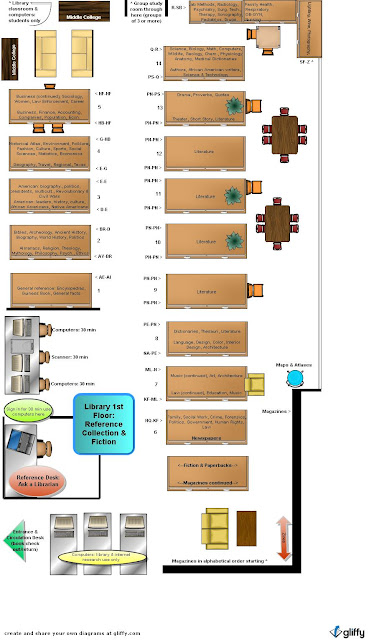
I've been dabbling in cartography for our library, drawing out (virtually) and labeling our downstairs and upstairs to help students navigate the stacks better (only showing first floor map here). We do have labels on the shelving, as well as LCSH guides, but this can help make it more visual and holistic.

I mentioned this task very briefly in a former post but now I have the finished products. We plan to post these maps on the bookcases, create smaller handouts students can take, and also post it on our website. Instead of just having a static map as a tab on our LibGuides, I made the suggestion we use photo editing software to create circles or highlights over each subject area's related locations to customize the maps for various departments.

As a review of Gliffy, I really liked it, and it's free. If you select to have objects snap to grid and align, it makes having repeating objects much easier to deal with. As you can see, there are also options for color and text styles/fonts. I also liked the variety of floorplan objects you can select to make furniture look close to what your library might have. Did I mention it's free? That's a huge plus.

The subjects chosen to be shown on the bookcase images (if you can even read them -- text is harder to read on the maps when posted here via Blogger) are ones that directly relate to classes offered and highlighted programs. For example, students are less likely to look up photography books here, and more likely to look up architecture and interior lighting for buildings because of our interior design program, and lack of a photography program.

It will hopefully be less intimidating for students to navigate the library having a map ahead of time; this should also really encourage browsing. I'm excited for when we get them posted to see what the reaction will be.

A slicker example I saw recently of a library map is the University of Arizona's virtual tour but I believe from what a colleague mentioned that it was not free. The pop-ups with photos do look really nice.